Marijuana Sales Tax

Durango Marijuana

Easter Island is a dark place. It’s an atoll sheltered by isolation deep within the Pacific Ocean, and it’s hard to hear the lessons that island screams because it’s too far away—leagues of surf and time have quieted the prescient warning. Think about it: when you first read the words “Easter Island,” you pictured one of those gigantic stone heads and scoffed at the notion that something so comical could come from a “dark place,” so you probably don’t believe me; you probably don’t know that those gigantic stone heads are the only remnants of a once proud culture that committed suicide with greed.

As a side note, yes, this is a blog about marijuana taxation, and yes, I promise to get to that in a second, but first, we need to go back a little bit (just bear with me because I promise it’ll all make sense in the end). So, here we go…

The Moai

The Rapa Nui were fierce voyagers. They made their clothing from palm fronds, their skin was covered with black tattoos. They lived off the ocean and first made landfall on the shores of Easter Island around thirteen-hundred years ago. Back then, the island was a paradise. It was tall and safe, with sheltering cliffs that broke incoming storms—egg-laying birds had made a rookery out of those cliffs, and the flocks were thick enough to feed all the Rapa Nui. The high-rolling hills of Easter Island were forested with budding fruit trees, the valleys were verdant and rich with fresh water. And the island lizards were so majestic that rainbows shot out of their asses every morning at sunrise… That last sentence wasn’t one-hundred percent accurate, but you get the point: the Rapa Nui had found a home better than the sea, so there they stayed.

But then one day, some dude carved one of those gigantic stone heads. And then some other dude on the other side of the island saw the gigantic stone head and decided to carve his own. This one was a little bit bigger, a little bit better. The carving started to spread. Things started to change. The Rapa Nui started felling their forests faster than the fronds could grow. Wood was needed for scaffolding and for the moving of larger and larger stones, and barren patches started to appear on the rolling hills of Easter Island like a metastasized cancer. The rookeries were picked clean, and if the biologists are to be believed, an entire species of cliff-dwelling seabird was eaten into extinction because the Rapa Nui were too busy carving gigantic stone heads to farm. The meat ran out and the forests disappeared and those island people who once lived on the sea turned to the caves. They dug into the hills, and in the end when things were at their worst, the Rapa Nui embraced cannibalism. The last man died one-thousand years after the first man landed, and all they left behind was a barren island covered with eight-hundred and eighty-seven gigantic stone heads called “The Moai.”

Greed did that; greed did all of that. And it’s not like our species has evolved that much in the three-hundred years that’ve passed since the Rapa Nui started eating each other; that same brand of insular capitalization is alive and well in our culture today. When we stumble upon something good, we milk it and milk it until there’s not much left to bleed dry, and then we move on to the next craze, the next thing to consume and use up. Today, right here right now in Durango, Colorado, we’re milking recreational marijuana by taxing the hell out of it.

For the record, I’m not saying that if we overtax marijuana we’ll turn to cannibalism like the Rapa Nui because that would be far too hyperbolic even for someone who smokes as much as I do. But I am saying that if we’re not responsible—if we don’t battle back the greed that defines our species—we’ll ruin something wonderful just as it’s starting to grow. And in that vein, the amount of sales tax that’s applied to recreational marijuana in this town is ludicrous. I’ll give you an example to prove my point. The total sales tax someone in Durango pays when he or she buys alcohol is 7.9%; three percent goes to the city, two percent goes to the county, and the remainder goes to the state. But when someone buys recreational marijuana in this town, he or she pays 20% in sales tax; three percent goes to the city, two percent goes to the county, and an exorbitant fifteen percent goes to the state of Colorado (and to make it more confusing, fifteen percent of that fifteen percent also comes back to Durango).

Doesn’t that seem somewhat unfair? I mean seriously, wouldn’t you think that the root cause behind drunk-driving fatalities should be taxed more than the reason this town is seeing such a boom in tourism? And to make it worse, “they” are considering a five percent increase in marijuana-related sales taxes in this town, thereby charging more than three times the rate levied against alcohol sales. The bump would all go to our city. It sucks, but you can read about it here in The Durango Herald if you’d like (a couple of your Best Buds from The Greenery were even interviewed).

To switch gears, I will admit that from the outside looking in, it probably seems like local marijuana dispensaries are making money hand over fist, and it probably seems like a good idea to tax the hell out of legal weed so this town can prosper. But unfortunately, statements like these are rife with ignorance. You see, marijuana dispensaries are taxed twice: we have to pay an extortionate amount of tax when we buy our pot wholesale, and then believe it or not, we have to pay anywhere from sixty to seventy percent in federal income tax after we sell our marijuana to the community (yes, you heard that right, the federal government doesn’t see anything wrong with taxing an industry that they refuse to legalize). At the end of the day, our profit margins are just as thin as they are in traditional retail industries, and we simply cannot afford another tax increase, especially since we’re still recovering from the one that just went into effect on July first.

The reason for this is that we simply cannot lower the retail prices on our quality marijuana and stay in business; we’d have to keep our base price constant and hope with crossed fingers that people would be willing to pay higher prices for legal weed. But would they? If this new tax is accepted and implemented, and top-shelf pot starts selling for around sixty-three dollars an eighth in this town, do you think people will still buy it legally, or do you think they’ll go back to “their guy” who sells the same bag of pot for fifty bucks on the street? Do you see what I mean? We’re taking too much; we’re chopping down too many trees. I know this tax sounds just a little bit bigger, a little bit better, but it’s just too much. It’s just another gigantic stone head when we already have plenty of Moai. It’s more than this small island of Durango can support, and our industry needs your help. So please, call our city representatives and county commissioners and tell them that we’re already paying enough; you can find city council contact information via this link and county commissioners contact info via this link. Or use our letter to mail your concern, Letter to County, City on Marijuana Tax.  Or better yet, please attend the upcoming County Commissioner Meeting at 5:30pm on July 20th in the Board Room of the County Administration Building and the City Council meeting at 6:30pm on August 15th in the Smith Chambers at City Hall and fight against this initiative because in the end, such a tax could limit your options when it comes to purchasing legal marijuana.

Thank you,

-The Greenery

LEARN MORE FACTS & DATA ON MARIJUANA TAXATION here Marijuana Tax Facts
Legal Marijuana, and Homelessness

Greenery Grown hand-crafted cannabis

I’ve never met Joseph Kolb, or anybody else from Fox News for that matter, but I’d like to. I’m pretty good at explaining things to people, especially matters of simple logic, and Mr. Kolb needs a lesson of sorts. Recently, he wrote an article for Fox News titled “Legalized marijuana turns Colorado resort town into homeless magnet,” and once I realized I was reading a nationally syndicated column as opposed to a tabloid, my smile turned upside-down. You can read it here, if you’re interested, but I’ll sum it up for you: Kolb was talking about our town, Durango, Colorado, and for twenty-two paragraphs, he wrote nonsense ad nauseam. This myopic man seriously thinks that legalized marijuana is ruining our town by luring in the homeless, even though from an objective point of view, things look a little differently. Let me explain.

It’s a logical fallacy of the worst order to tie two things together without researching the connection. As an example, I stubbed my toe when I got out of bed this morning, and at the same time, the sun was popping up above the horizon. But when I told my wife about it, I didn’t say “honey, I stubbed my toe when the sun came up today, ergo, solar radiation is making me clumsy,” because such an assertion would be asinine gibberish.

Basically, Kolb took two unrelated facts and tied them together with no regard for journalistic integrity whatsoever. True, the legalization of recreational marijuana came to our town in 2014, and our homeless population started booming around the same time, but the two occurrences are unrelated. In 2014, the ACLU sent a letter to Durango’s city council wherein they threatened to sue if our local police kept enforcing our “anti-loitering” ordinance. According to the ACLU, it’s an infringement of free speech to stop homeless people from panhandling, because when they write “anything helps” on a piece of cardboard, they’re exercising a constitutional right… seems legit. Anyway, the cops stopped herding the homeless away from Main Avenue because the ACLU isn’t an organization to take lightly. The homeless people in this town took note, they told their friends, and the rest is self-explanatory.

Our town is beautiful. We have a narrow-gauge railroad straight out of antiquity; we have world-class skiing in the winter; we have an ever-adapting whitewater course on the Animas River that runs through this town like an artery. We have abundant camping spaces and temperate weather and affluent locals. We have bars and comfortable park benches and a generous homeless shelter. And most importantly, we have cops who won’t bother you if you want to dress in a sleeping bag and stand on Main Street with your hand out.

That’s why our homeless population is booming—it has nothing to do with legal pot, and people who think otherwise are subscribing to old-think. These are the same fools who watched “Reefer Madness” and took it as gospel—these are the same people who rallied against legalized marijuana, and now that they’ve lost, they’re grasping for straws and doing their damnedest to find an “I told you so” buried somewhere amongst all the positive results stemming from decriminalization. And as a professional in the marijuana industry, my frustration is palpable.

I sell pot for a living, and I can tell you from personal experience that our clients come from all walks of life. I’ve served giddy college seniors, bubbling about the fact that they just turned twenty-one. I’ve served sweet old ladies, smiling like my grandmother, who’re happy to get carded because octogenarians have forgotten what it feels like. I’ve served people who’re just as broke as I am, and I once served a man wearing a watch worth more than my education. These people hold down jobs and pay taxes and care for their families just like Americans are supposed to. And unfortunately, people like Kolb can’t see these things because they write about our town from far away, looking at us through a tinted telescope of assumption. They tie to legalized marijuana unfair and negative “facts” because people like Kolb harbor a personal prejudice against legal pot, and at times, it seems as if no amount of factual evidence can dilute their bias. It’s unfortunate, but I guess it’s just part of the game.

All I can do is tell you this: here at The Greenery, we know that legal marijuana is a good thing, and we take our jobs seriously. We have to—we’re stewards of an industry facing a good deal of ignorant skepticism. We run a clean and legal operation, and our attention to regulation compliance borders on the obsessive. And for as long as we’re around, we’ll do our best to educate our customers and our community vis-à-vis the truth about legal marijuana, so please, keep checking in, and as always, if you have any questions, call your Best Buds at (970) 403-3710. Thank you.

Discretion

The Greenery checks age requirements in Colorado

Marijuana is perfectly legal for recreational use in Colorado, and frankly, it should be. Pot is a plant that grows out of the ground, and if you light it on fire and breathe in the smoke, it makes you feel good. For many, it’s a medicine—one that doesn’t bring with it the crippling side effects commonly associated with traditional pharmaceuticals—and medicine should be legal. It’s a simple truth, one that’s axiomatic to those of us who know the difference between right and wrong, and that’s why I support legalized marijuana; that’s why I’ve chosen to work in this industry.

However, I also understand that not everybody feels this way. Plenty of people still think that pot is a problem. They look at that plant and see a vice that needs to be eradicated, and they subscribe to the antiquated paradigm that kept marijuana illegal for decades. Some people fear change; that’s just the way it is. So, occasionally, discretion is necessary.

I’m one of the fortunate few who can be who I am both at work and in my personal life because my coworkers, friends, and family all have modern views regarding marijuana. In short, I don’t have to hide the fact that I smoke pot—hell, I’m pretty loud about it sometimes. But you might not have that luxury, and here at The Greenery, we understand, and we offer a level of discretion you won’t find at other dispensaries.

For one, we have a discreet location. We’re nestled in at 208 Parker Avenue, right behind Morehart Murphy. We’re close enough to be convenient, but far enough away to keep things comfortable. When you leave our shop, you won’t have to run that downtown gamut where it seems like you recognize everyone around you on the street. You won’t have to walk down a long alley carrying a bag full of marijuana back to your car parked on Main; you won’t have to feed a meter. We’re open early and we close late, and you can come and go with a level of privacy not offered elsewhere. But that’s not the most important part: here at The Greenery, we don’t track your purchases.

I’ll admit that I shopped around at other dispensaries before I worked at The Greenery. I was a creature of habit, and I didn’t stray far from my home when I went shopping, be it for groceries or marijuana; I usually stayed on the north-side of town for convenience. And it didn’t really bother me that the other dispensaries tracked my purchases (you know, because I’m “loud about it”), but in retrospect, the practice is a little sketchy.

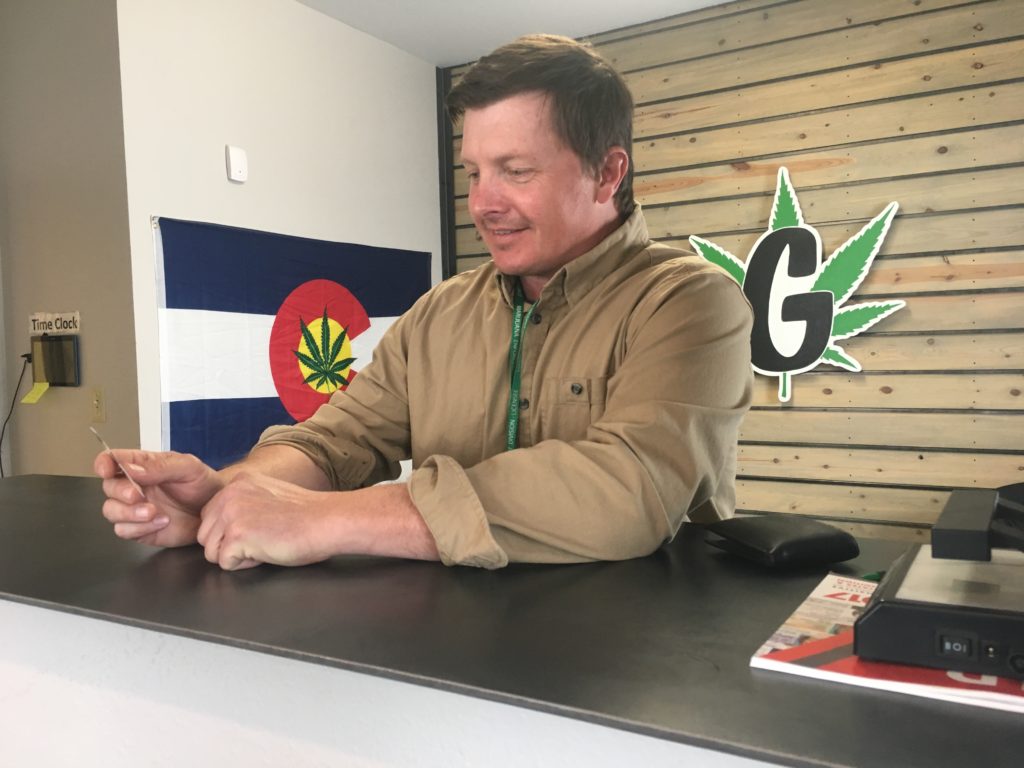
I’m sure you’ve noticed it. Most dispensaries will swipe your ID when you walk in to make sure you’re twenty-one. One place even has a metal turnstile that opens only after you’ve swiped your card, in case you’ve ever wondered what it’d be like to get carded by a robot. But guess what: every time your ID is swiped, the machine keeps a record of your visit. So here at the Greenery, we take the time to read your ID by hand. Granted, it might take us a little longer because we have to check diligently your picture and your birthdate and your card’s expiration date, but that’s something we do for you because it’s your business if you buy marijuana, and nobody else’s.

Secondly, we don’t track your purchases at the register. True, we have a loyalty program—an awesome one that I’ll tell you about in a different post—but we use punch cards instead of an electronic system. There’re other dispensaries here in Durango that keep track of every single purchase you make, and they do so via a computer database that’s just as vulnerable to hacking as all the other systems in this inescapable digital age. With the click of a mouse, anyone who cares to look can find a record of all the marijuana you’ve purchased, and considering the fact that federal laws haven’t yet caught up to our local ones, some people prefer the discretion offered here at The Durango Greenery.

So, come see us, your best buds. Come find a place in our parking lot and walk through our front door. Someone will check your ID with a smile and then give it back without recording your visit. We’ll sell so you some ridiculously good pot, and then you can go on your way, legally, rightfully, and discreetly. Cheers.

We’re Your Best Buds!

Extended Marijuana Dispensary Hours on the Horizon in Durango!

Extended Marijuana Dispensary Hours on the Horizon in Durango

Extended Marijuana Dispensary Hours on the Horizon in Durango!

Marijuana may be much more available in Durango, Colorado, if all goes as proposed.

On June 14, 2016, the Durango city council discussed the possibility of extending Durango medical and recreational marijuana dispensary operating hours to midnight.

Currently, a Durango ordinance, as well as the Land Use and Development Code (LUDC) rules, state that dispensaries can operate only between 8 am and 8 pm, though the Colorado state regulations allows marijuana dispensaries to stay open until midnight.
In an effort to raise more tax dollars and compete with the black market, the Durango city staff is proposing this LUDC amendment to the Planning Commission on June 27, 2016 and to the City Council on July 19, 2016. If the new ordinance passes, the change will take effect August 31, 2016.
To see the full agenda for the meeting, click here.

Additional Source: http://www.durangoherald.com/article/20160614/NEWS01/160619777/Marijuana-shops-could-have-extended-hours

California Recreational Marijuana Initiative on the Verge

California Recreational Marijuana Legalization

California Recreational Marijuana Initiative on the Verge

The Golden State is on its way to legalizing the recreational use of cannabis! (California 2016 ballot propositions 5/14/16).
Throughout history California has been an innovator in progressive cannabis culture. The state decriminalized marijuana in 1975 and in 1996 they became the first to legalize medicinal marijuana. Now, they are taking another step to legalize cannabis for the recreational user.

In November, 2016 the legalization of recreational marijuana will be on California’s ballot.

Lieutenant governor Gavin Newsom leads a group of proponents that have gathered over 600,000 petition signatures, more than meeting the 365,880 requirement. (CAL NORML Guide to the Adult Use of Marijuana Act of 2016 AUMA, 5/24/16).
This movement, coined the Adult Use of Marijuana Act (“AUMA”), would take California into the same leagues as Colorado, Oregon, Washington, Alaska, and Washington D.C. This grass roots movement wants to pass legislation which includes allowing a person 21 or over to possess as much as one ounce of marijuana for private recreational use, also allowing for personal marijuana cultivation of up to six plants.
The act would establish a system to license, regulate, and tax recreational marijuana dispensaries, while allowing individual cities the right to govern sales within city limits. Accordingly, hundreds of millions of dollars would be set aside for substance abuse prevention and treatment, law enforcement, and research. (CAL NORML Guide to the Adult Use of Marijuana Act of 2016 AUMA, 5/24/16).
Although heading in the right direction, California voters failed to legalize marijuana in the recent past by rejecting Proposition 19 in 2010. It was defeated with 53.5% voters voting against and 46.5% voting for the proposition. If passed it would have had similar guidelines to the AUMA, legalizing various marijuana related endeavors and permitting local governments to regulate said activities. Supporters argued, as they do now, that regulation and taxation would help with California’s budget shortfall, would redirect law enforcement resources to more dangerous crimes, and would reduce a source of funding for drug cartels. (California Proposition 19, the Marijuana Legalization Initiative).
The vote in November is the next step California is taking to move into the arena of states that have increased statewide revenue and jobs, while decreasing opiate related deaths and domestic abuse (The Progressive Cynic, 8/29/2014).

“This November, California voters will finally have the opportunity to pass smart marijuana policy that is built on the best practices of other states, includes the strictest child protections in the nation and pays for itself while raising billions for the state,”  Lt. Governor Newsom said in a recent statement.

The California Medical Association touts the measure saying “the most effective way to protect the public health is to tightly control, track and regulate marijuana and to comprehensively research and educate the public on its health impacts, not through ineffective prohibition.” (CA Medical Association Announces Support for Responsible Marijuana Ballot Initiative, 2/1/16, para. 5)

Marijuana & Pesticides in Colorado

Marijuana Plants - Durango CO

Marijuana & Pesticides in Colorado

Many of you have probably read about the rise in pesticide recalls in Colorado’s retail marijuana & marijuana products. This may have you wondering: is Colorado’s marijuana safe?
This is the first in a series in which we explore pesticides in the Colorado marijuana industry. The aim of this post is to provide you with some insight into what requirements are placed on marijuana dispensaries and cannabis cultivation businesses when it comes to pesticide application. The second post in the series will explore how the pesticide requirements have affected Colorado dispensaries.
On November 12, 2015, Governor Hickenlooper issued Executive Order D 2015-015, sometimes referred to as the “Zero Tolerance” executive order.  This executive order directed Colorado state agencies to address threats to public safety posed by marijuana contaminated by pesticides.
The executive order calls out a few important points:
• The Environmental Protection Agency (“EPA”) regulates pesticides in the United States;
• Given that marijuana is a schedule I narcotic under the Controlled Substances Act, the EPA has neither:
(a) assessed the potential hazards associated with the use of pesticides on marijuana; or
(b) authorized application of particular pesticides to marijuana
Colorado also regulates pesticide applications through the Colorado Pesticide Applicator’s Act (“PAA”). PAA prohibits use of pesticides inconsistent with the EPA’s labels and directions.

Therein lies the predicament:  Colorado’s PAA relied on directive from the EPA, but the EPA had not provided guidance on pesticide application for marijuana because it is still an illegal drug at the federal level.

As a result of the executive order, and in an effort to develop a list of pesticides that would be permitted for use on marijuana, the CDA consulted with the EPA. Specifically, as stated above the PAA and the  Federal Insecticide, Fungicide and Rodenticide Act (FIFRA) require that all pesticides be applied in strict accordance with the label directions for the particular product. The heart of the issue is that pesticide labels identify the type of “crop” for which the the pesticide is permitted to be used.  At this time, there are no pesticides listing “cannabis” as a crop on the label.
Thus, the CDA created a list of pesticides that are permitted to be used on marijuana. That list is regularly updated and can be found on the CDA’s website. In testing marijuana, should the CDA find any trace of a pesticide that is not on the approved list, the marijuana will be placed on hold, likely resulting in a recall.
In the next post in this series, we will explore how these strict pesticide application rules have affected marijuana dispensaries across the state of Colorado.

2016 Presidential Candidates Views on Marijuana Legalization

2016 Presidential Election and Marijuana

2016 Presidential Candidates Views on Marijuana Legalization

With the current presidential candidates dwindling down in numbers, we here at The Greenery in Durango, Colorado have to wonder what changes could affect our recreational marijuana dispensary with the general election right around the corner.
Let’s take a look at the three candidates who are still in the race to see where they stand on the legalization of marijuana:

Donald Trump (R)

He could be one of the most interesting candidates to run for president of the United States to date. Trump’s view on the legalization of marijuana has changed just a few times:
Back in 1990 at a speech in Miami, Florida he once said We’re losing badly on the war on drugs. You have to legalize drugs to win that war. You have to take the profit away from these drug czars.”Sarasota Herald- Tribune April 14, 1990.
At the Conservative Political Action Conference in June 2015 in discussing the legalization of marijuana, Trump stated “I say it’s bad. Medical marijuana is another thing, but I think it’s bad, and I feel strongly about it,” further stating “[T]hey have got a lot of problems going on right now in Colorado. Some big problems.” Washington Post, June, 2015
More recently Trump expressed his opinion of medical marijuana legalization versus recreational marijuana legalization. After Nevada legalized medical marijuana in October 2015, Trump was speaking at a rally outside of Reno and stated “Marijuana is such a big thing… I think medical should happen – right? Don’t we agree? I think so. And then I really believe we should leave it up to the states.”Washington Post, October 29, 2015
So where does Trump stand? On the Bill O’Reilly show in February 2016 when asked about his position on marijuana legalization in Colorado:  “I would, I would really want to think about that one Bill because in some ways, I think it’s good and in other ways, it’s bad.” – Bill O’Reilly show, February 10, 2016
All in all, it seems Trump supports each state’s right to vote on medical marijuana, but as far recreational use and legalization goes, it’s hard to tell officially where Trump stands.
Thus, we at The Greenery agree with the Marijuana Policy Project and give him a C+ rating for his views on the legalization of marijuana.

Hillary Clinton (D)

Hillary Clinton has a more solid stance, but will not firmly state whether she supports or opposes marijuana legalization. She does believe marijuana needs to be dropped from a Federal Schedule I Drug to a Schedule II so it can be further researched. – Claflin University on Nov. 7, 2015
Hillary historically indicated that she wants to take the “wait and see” approach to the legalization of marijuana.  She once stated: “I’m a big believer in acquiring evidence, and I think we should see what kind of results we get, both from medical marijuana and from recreational marijuana, before we make any far-reaching conclusions…We need more studies. We need more evidence. And then we can proceed.”  – CNN Politics, October 16, 2014
When recently ask if she has taken a stance on marijuana legalization, Hillary responded “No. I think that we have the opportunity through the states that are pursuing recreational marijuana to find out a lot more than we know today. I do support the use of medical marijuana, and I think even there we need to do a lot more research so that we know exactly how we’re going to help people for whom medical marijuana provides relief.” 2016 Democratic Presidential Debate, October 13, 2015
In addition, Hillary indicated her support for Colorado and said: “I really believe it’s important that states like Colorado lead the way, so that we can learn what works and what doesn’t work. And I would certainly not want the federal government to interfere with the legal decision made by the people of Colorado, and enforced by your elected officials, as to how you should be conducting this business that you have approved.” MSNBC, October 14, 2015
While Hillary doesn’t seem to have committed to a particular stance on the legalization of marijuana, she has recently said that she supports states moving toward medical marijuana and moving toward legalizing it for recreational use. – Jimmy Kimmel Live, March 24, 2016.
Hillary’s support for the state of Colorado’s legalization of marijuana is a positive sign despite her failure to take an official stance on the legalization of marijuana at the federal level.
We again agree with the Marijuana Policy Project’s rating of a B for Hillary as it relates to her viewpoints on the legalization of marijuana.

Bernie Sanders (D)

Bernie’s has “burned” before: the politician admitted that he tried marijuana twice in his life, ultimately deciding it wasn’t for him. – Washington Post, June 2, 2015
As of now, Bernie Sanders supports each state’s decision to legalize marijuana medical and recreational marijuana use. With that, he also supports federal legalization of marijuana in addition to lifting the federal prohibition, allowing states to decide whether to legalize.  This would also allow marijuana businesses and entrepreneurs to have access to the banking system. – Vice News, October 29, 2015
Bernie is also proclaimed to be a co-sponsor for the Marijuana Businesses Access to Banking Act of 2015, which provides a safe harbor for financial institutions providing depository services to legitimate marijuana businesses. – US Congress, July 9, 2015
Check out Bernie’s website for further information on his stance regarding the marijuana legalization and the war on drugs.
Given Bernie’s consistent stance on the legalization of marijuana for both recreational and medical use, Bernie gets an A rating from The Greenery when it comes to his views on this issue.

A Big Grin for Legal Marijuana in Colorado

Marijuana in Durango Colorado
March 25, 2016

If you listened hard enough, you could hear the collective sigh of relief throughout Colorado’s legal marijuana industry when the Supreme Court’s decision to deny hearing the Oklahoma/Nebraska v. Colorado lawsuit hit the news.

Flashback to December 2014 –
Oklahoma and Nebraska filed a lawsuit with the U.S. Supreme Court against Colorado. In their original complaint, the two states argued that marijuana purchased in Colorado flows into neighboring states, such as Nebraska and Oklahoma, undermining those states’ own marijuana bans, draining their treasuries, and placing stress on their criminal justice systems.
Oklahoma and Nebraska requested the Court to determine that Amendment 64 of the Colorado Constitution be preempted by federal law, thus making Amendment 64 unconstitutional and unenforceable. In other words, the states wanted to make the recreational use of marijuana illegal in Colorado again.

But the problem is, it’s not just Colorado who legalized recreational use of marijuana – so hearing this case may have just been the beginning.

Alaska, Washington, Oregon, and the District of Columbia have all legalized marijuana for recreational purposes. Also, 23 states and the District of Columbia have legalized some form of access to medical marijuana.
In addition to states trending more toward the legalizing of marijuana, in August 2013, the Department of Justice stated it would not interfere in states that choose to regulate marijuana.
Flashforward to February 2016 –
As the Supreme Court was about to discuss this important case, Justice Scalia unexpectly passed away, throwing everyone into speculation on the new timeframe of the decision.
But after a brief delay, the 6-2 decision to deny the states’ request to hear the case was announced the week of March 21, 2016. Which brings us to our collective  *sigh*.
Colorado’s legal recreational marijuana dispensaries have a lot of challenges ahead, but with the string of losses in court for those challenging these laws, the future is looking brighter!

Sources/References:

https://www.leafly.com/news/headlines/supreme-court-rejects-states-challenge-to-colorado-cannabis-law

http://www.thecannabist.co/tag/nebraska-oklahoma-lawsuit/

http://www.durangoherald.com/article/20160321/NEWS01/160329952/US-Supreme-Court-refuses-to-hear-marijuana-case-against-Colorado

http://www.commondreams.org/newswire/2016/03/21/scotus-votes-6-2-rejects-hearing-ne-ok-lawsuit-against-co-marjijuana

http://www.usatoday.com/story/news/2016/03/21/marijuana-lawsuit-colorado-oklahoma-nebraska-supreme-court/81984006/